AI Infrastructure and AI Platform Engineer Jobs
265 AI infrastructure, AI platform, MLOps and inference roles at 94 tech companies on 14 November 2026: what the work is, who's hiring and where.
AI infrastructure and AI platform engineers build the systems that train AI models, serve them to users and keep them running: GPU clusters, inference servers, and the tools other engineers use to ship models. On 14 November 2026, 265 such roles were open at 94 of the 720 tech companies Tideline follows, 210 of them engineers and scientists at 86 companies. Inference is the largest group, the roles are mostly senior, and only a fifth are remote.
This article explains what the work involves, how AI infrastructure, AI platform, MLOps and AI engineering differ, and who is hiring, where and how. It counts roles whose titles name AI or ML infrastructure, an AI or ML platform, MLOps, inference, training infrastructure or GPUs. For AI hiring in general, AI engineers, machine learning engineers and researchers, see AI Jobs: Which Companies Are Hiring for AI Roles Right Now and the live list AI and machine learning jobs: who’s hiring today.
What an AI infrastructure engineer does
An AI model’s life has two halves. Training is the phase in which a model learns from data, usually on large clusters of GPUs or other accelerators. Inference is when the trained model is put to work: NVIDIA describes it as where the capabilities learned during training are put to use, answering a question, ranking a feed or generating an image. Infrastructure engineers build and run the machinery for both, and the work in between: moving data, scheduling jobs, deploying models, measuring cost and keeping everything up.
Four postings open on 14 November 2026 show the range:
- Perplexity AI’s AI Inference Engineer (San Francisco, Palo Alto or New York) works on the serving side: supporting new model types, managing GPU memory for the model’s working state (the KV cache), scheduling requests, porting GPU code to NVIDIA’s newest chips, and building an inference server in Rust to replace slower Python serving. It names CUDA, Triton, PyTorch, JAX and Kubernetes, and asks for three or more years with real work on inference or high-performance systems.
- Roblox’s principal engineer for its Build Platform (San Mateo, in the office Tuesday to Thursday) owns the architecture of a platform for AI agents in production: reliability, safety, observability and cost, including usage metering and routing requests between models, and the infrastructure to evaluate agent quality. It asks for eight or more years of large-scale distributed systems.
- Braze’s Staff Machine Learning Engineer, ML Platform (hybrid) sets the direction for how models are trained, deployed, served and monitored, leads machine learning incident response and builds model-serving fleets across several regions. It names Kubernetes and Python, with Ray, MLflow and Kafka as a plus, and asks for eight or more years.
- Graphcore’s Infrastructure and MLOps Engineer (Bristol) builds and runs the tools and services its AI research teams use: Kubernetes and Docker, cloud infrastructure in Terraform or OpenTofu, and better build, test and release processes for machine learning software.
The common ground is distributed systems and Kubernetes; the specialist ground is GPUs and the software that drives them (CUDA and NVIDIA’s libraries in Perplexity’s posting). Experience asked runs from three years to eight.
AI infrastructure vs AI platform vs MLOps vs AI engineer
The titles overlap, and companies use them differently, but each has a centre:
| AI or ML infrastructure | AI or ML platform | MLOps | AI engineer | |
|---|---|---|---|---|
| Centre of the job | Compute, clusters, training and serving systems | Shared tools that other engineers use to build with models | Turning models into reliably run, monitored software | Building AI features and products for users |
| Typical work | GPU clusters, inference servers, scheduling, cost | Model deployment, serving and evaluation services, internal APIs | Pipelines for training and deployment, monitoring, retraining | Applications that call models, prompts, retrieval, evaluation |
| Roles in this data | 51 (36 AI, 15 ML) | 86 (63 AI, 23 ML) | 17 | Covered in AI Jobs |
MLOps has the clearest definition. Google Cloud describes it as a machine learning engineering culture and practice that aims at unifying ML system development and ML system operation, in the way DevOps joins software development and operations. Its guide explains why machine learning needs it: models are built through experiments that are hard to reproduce, testing has to cover data and model quality as well as code, deployment is often a pipeline that retrains models rather than a single release, and models get worse in production as the data changes, so both data and performance need watching. The guide describes three levels, from a manual process (level 0) to automated training pipelines (level 1) and fully automated delivery of those pipelines (level 2).
AI platform titles are the bridge: DevOps Engineer Jobs describes platform engineering in general, building internal tools that product teams use by themselves; AI platform engineers do the same for teams that build with models.
How many AI infrastructure and platform jobs are open right now
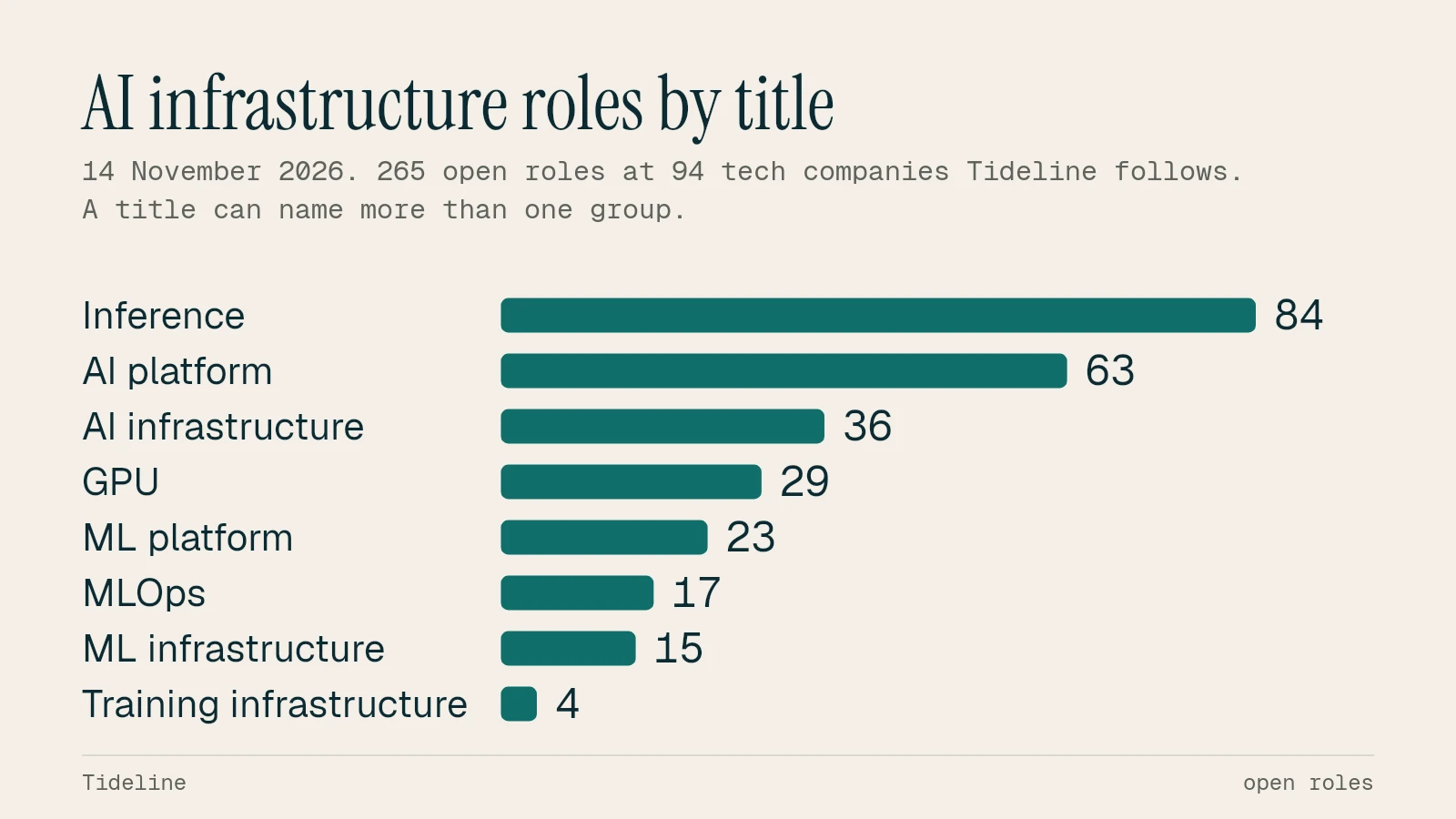
By the words in the title (a title can name more than one group, so these overlap):
| Title group | Roles | Companies | Most roles |
|---|---|---|---|
| Inference | 84 | 26 | Cerebras 19, Nebius 14, Anthropic 9 |
| AI platform | 63 | 37 | Wrike 9, Harvey AI 4, Smartly.io 4 |
| AI infrastructure | 36 | 16 | Extreme Networks 8, Nebius 4, OpenAI 4 |
| GPU | 29 | 15 | Nebius 7, Civo 5, Cerebras 3 |
| ML platform | 23 | 15 | Braze 4, then 2 each at Aidoc, Appian and N26 |
| MLOps | 17 | 12 | Graphcore 3, then 2 each at Canonical, Gen Digital and Zyte |
| ML infrastructure | 15 | 10 | 2 each at Lightmatter, OpenAI, Roblox and SambaNova Systems |
| Training infrastructure | 4 | 4 | One each at Cohere, Perplexity AI, Reflection AI and Sarvam AI |
| All | 265 | 94 |
Ten titles name two groups, and four AI-related infrastructure titles name none of them (“Infrastructure Engineer (ML Compute)”, for example) but are counted.
Not every role is an engineer. By the kind of title:
| Kind of title | Roles | Companies |
|---|---|---|
| Engineers and scientists | 210 | 86 |
| Engineering managers, directors and leads | 29 | 20 |
| Product managers | 17 | 7 |
| Other roles (strategy, planning, field roles) | 9 | 6 |
Most of the product manager roles are one posting: Wrike’s Senior Product Manager, AI Platform and Ecosystem, listed nine times.
Training infrastructure is the smallest group, with one role each at Cohere, Perplexity AI, Reflection AI and Sarvam AI. Inference roles outnumber training roles twenty to one in this data.
Companies hiring for AI infrastructure and platform roles
Twenty-one companies have four or more of these roles open. Fourteen have five or more, 130 roles between them; 46 companies have just one. Each company name links to its Tideline page, with every role it has open today.
Tideline is independent and is not affiliated with any company or job platform mentioned here. Company names are used only to identify where roles are open.
| Company | Roles | Main locations | Remote |
|---|---|---|---|
| Nebius | 25 | Amsterdam (8), Berlin (7), London (7) | 10 |
| Cerebras | 19 | Sunnyvale (18), Toronto (16) | 0 |
| Anthropic | 13 | San Francisco (12), New York (8), Seattle (8) | 1 |
| OpenAI | 9 | San Francisco (9), New York (1), Seattle (1) | 0 |
| Wrike | 9 | Nicosia (1), Prague (1) | 7 |
| Extreme Networks | 8 | Bengaluru (8), Chennai (8) | 0 |
| Cohere | 7 | New York (4), San Francisco (4), Toronto (4) | 5 |
| Mistral AI | 7 | London (4), Paris (4), New York (3) | 0 |
| Roblox | 7 | San Mateo (7) | 0 |
| Perplexity AI | 6 | San Francisco (4), New York (3), London (2) | 1 |
| Civo | 5 | No city given | 0 |
| Databricks | 5 | San Francisco (4), Mountain View (1) | 0 |
| Elastic | 5 | No city given | 0 |
| xAI | 5 | Palo Alto (5), Seattle (1) | 0 |
| Braze | 4 | Austin (1), Chicago (1), New York (1) | 0 |
| H Company | 4 | London (3), Paris (3) | 0 |
| Harvey AI | 4 | New York (2), San Francisco (2) | 0 |
| SambaNova Systems | 4 | San Jose (4), Austin (2) | 0 |
| Sarvam AI | 4 | Bengaluru (3), Chennai (2), New Delhi (1) | 0 |
| Smartly.io | 4 | Berlin (2), Helsinki (2) | 0 |
| VESSL AI | 4 | Seoul (4) | 0 |
Three kinds of company stand out: AI labs (Anthropic, OpenAI, Mistral AI, Cohere, xAI, Perplexity AI); companies that sell computing for AI (Nebius, Cerebras, Civo, SambaNova Systems); and software companies such as Roblox, Braze, Databricks, Elastic and Smartly.io, which post AI platform and inference roles too.
Spotted an error or want a listing corrected? Email [email protected].
Inference engineer jobs
Inference is the biggest group: 84 roles at 26 companies. Cerebras has 19, across an inference platform, an inference cloud, inference APIs, GPU inference and the testing and release of its inference stack; Nebius has 14, including applied scientists and machine learning engineers whose titles name efficient large language model inference and optimisation; Anthropic has 9 and Elastic 5 (search inference).
Inference roles appear at AI labs, at companies that sell computing and at software companies alike. The Perplexity posting above shows the typical work: memory management on the GPU, batching requests together, low-level performance tuning and the server software around it.
AI platform, AI infrastructure and GPU roles
AI platform (63 roles at 37 companies) is the most widely spread group. Its engineering titles are Senior AI Platform Engineer (6 postings), Staff Software Engineer, AI Platform (4), Principal Engineer, AI Platform (3) and Staff AI Platform Engineer (3), at companies from Harvey AI and Smartly.io (4 each) to Databricks (3); MariaDB posts a Senior Analytics AI Platform Engineer three times. Wrike’s nine product manager postings sit in this group too. ML platform (23 at 15) is a closely related title, led by Braze (Staff Machine Learning Engineer, ML Platform, four postings) and Appian (Principal ML Platform Engineer).
AI infrastructure (36 at 16) is concentrated: Extreme Networks has 8 (AI systems engineers in Bengaluru and Chennai), then Nebius and OpenAI (4 each) and Civo (3). Titles run from AI Infrastructure Engineer to forward deployed engineers for physical AI infrastructure at Nebius, solution engineers for GPU and AI infrastructure at Civo, and planning and strategy roles. ML infrastructure (15 at 10) adds Machine Learning Infrastructure Engineer and Researcher titles at Lightmatter, OpenAI, Roblox, SambaNova Systems, Anthropic and AppLovin.
GPU (29 at 15) titles name the hardware directly: GPU Cluster Architect (3 postings), solution engineers for GPU and AI infrastructure, GPU infrastructure support, GPU simulation research and GPU kernel work, and Anthropic’s Engineering Manager, GPU (ML Accelerator). Nebius (7), Civo (5) and Cerebras (3) post the most. These are the roles closest to the hardware: the clusters, drivers and low-level code that everything above depends on.
MLOps engineer jobs
17 roles at 12 companies have MLOps or ML Ops in the title: Graphcore (3, Infrastructure and MLOps Engineer), Zyte (2, Staff Engineer, Core and MLOps), Canonical (2, an MLOps field engineer and an engineering manager), Gen Digital (2, an MLOps engineer and an engineering manager), and one each at Cognism, Cohere, Doctolib, Global Relay, Hudl, Intuition Machines, Ippon Technologies and Sarvam AI.
The 17 roles here are only those whose titles use the word. AI platform, ML platform and infrastructure roles can include similar work under other titles, so the count is a floor, not the full picture.
Remote AI infrastructure jobs and eligible regions
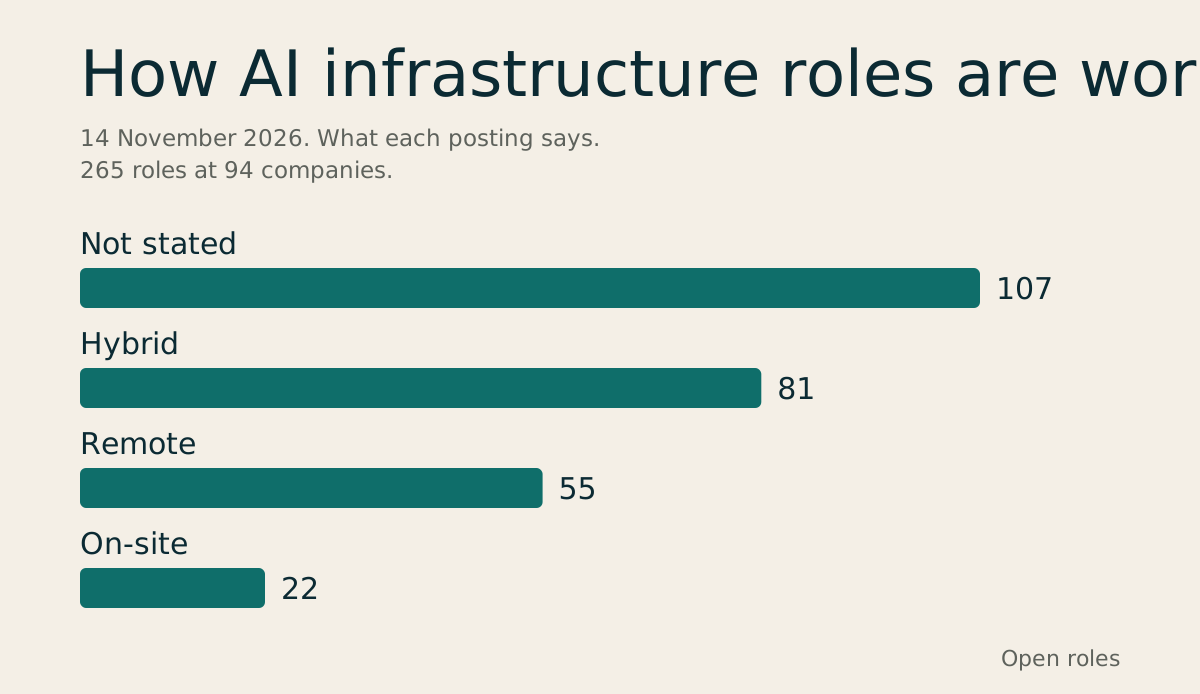
55 of the 265 roles are marked remote (21%), 81 hybrid and 22 on-site; 107 don’t say. That is lower than most tech fields in Tideline’s data (27% across all of them), and close to AI and machine learning as a whole (20%).
Nebius posts the most remote roles (10), then Wrike (7, all product manager roles), Cohere (5), and MariaDB and Pinterest (3 each). Where a remote role says where you can be based, 17 are open in a country or region in Europe, 16 in the United States only and 3 anywhere in the world; 16 don’t say.
Senior and junior AI infrastructure roles
| Level in the title | Roles |
|---|---|
| Senior | 73 |
| Staff | 58 |
| Principal | 14 |
| Lead | 7 |
| Manager or director | 43 |
| New grad | 2 |
| No level in the title | 68 |
152 of the 265 (57%) say senior, staff, principal or lead, and 43 are managers or directors. Only two are for new graduates: Quora’s Software Engineer New Grad, Machine Learning Platform, and SambaNova Systems’ ML Infrastructure Engineer, New Grad. Staff titles are unusually common (58), and the postings above ask for three to eight years of experience.
Where AI infrastructure jobs are
| Country | Roles |
|---|---|
| United States | 144 |
| United Kingdom | 35 |
| Canada | 29 |
| India | 18 |
| Germany | 16 |
| France | 15 |
| Netherlands | 10 |
| Poland | 10 |
| South Korea | 8 |
A role can list more than one place, so these overlap. By city, San Francisco leads (55), then London (29), New York (27), Toronto (23), Sunnyvale (18), Palo Alto (15), Paris (14), and Bengaluru and Berlin (13 each). The San Francisco Bay Area (San Francisco, Sunnyvale, Palo Alto, San Mateo and San Jose) is the centre, with Cerebras in Sunnyvale and Toronto, and Nebius spread across Amsterdam, Berlin and London.
Finding AI infrastructure jobs on Tideline
- AI and machine learning jobs: who’s hiring today lists every open AI and ML role, live.
- Search for “inference” or for “MLOps”, and narrow by country, remote and work setting.
- Each company above has its own Tideline page, such as Nebius or Cerebras.
- Related: AI Jobs for AI hiring in general, AI Automation Jobs for roles building AI agents, and DevOps Engineer Jobs for infrastructure work outside AI.
Every role links to the employer’s own page. Before you apply, Readback shows your resume the way the hiring software on the other side reads it.
How this data was collected
Tideline reads the public job boards of the 720 tech companies it follows, once a day each, on Greenhouse, Ashby, Lever, Teamtailor, Workable and Personio. It does not read job sites or aggregators, and it does not cover every employer. On 14 November 2026, 714 of those companies had open roles, 36,878 in all.
A role counts here when its title names AI infrastructure, ML or machine learning infrastructure, an AI platform, an ML or machine learning platform, MLOps or ML Ops, inference, training infrastructure or GPUs, as whole words, in any field except Tideline’s “other functions”; or when an infrastructure engineer title also names AI, machine learning, GPUs or models.
Data notes:
- 3 data scientist titles about “causal inference”, a statistics method, are left out.
- 6 matching roles in “other functions” (partnerships, finance, sourcing and policy) are left out.
- 22 AI and machine learning infrastructure roles that matched the DevOps article’s words are counted here, not there.
- 196 of the 265 also count in AI Jobs under its rules, as their titles name AI or machine learning.
- Levels and kinds of title come from the words in each title. Engineers and scientists are titles with engineer, developer, architect, scientist, researcher, programmer or member of technical staff, without manager, director, sales, marketing, strategy or planning words; product managers and engineering managers are counted apart.
- Title groups overlap: ten titles name two groups (an inference platform, for example), so the group counts add up to more than 265.
- The postings described were read on 14 November 2026; Roblox’s posting appears in its own system under the title “Principal Software Engineer, Build Platform”.
- The figures describe the companies Tideline follows on 14 November 2026, not the whole market for these roles.
Common questions
- What does an AI infrastructure engineer do?
- An AI infrastructure engineer builds and runs the systems that AI models depend on: clusters of GPUs and other accelerators, the software that trains models on them, and the services that run trained models for users (inference). Postings read on 14 November 2026 describe work such as building inference servers, managing GPU memory, scaling model serving across regions and running Kubernetes for research teams.
- What is the difference between an AI platform engineer and an AI engineer?
- An AI engineer usually builds AI features or products for users; an AI platform engineer builds the shared tools and services that those engineers use to train, deploy, serve and monitor models. In Tideline's data on 14 November 2026, 63 roles named an AI platform and 23 a machine learning platform.
- What is MLOps?
- Google Cloud describes MLOps as an ML engineering culture and practice that aims at unifying ML system development and ML system operation, much as DevOps does for software. On 14 November 2026, 17 roles at 12 of the companies Tideline follows had MLOps or ML Ops in the title.
- Which companies are hiring AI infrastructure engineers?
- On 14 November 2026, Nebius had the most AI infrastructure, platform and inference roles open (25), then Cerebras (19), Anthropic (13), OpenAI and Wrike (9 each), Extreme Networks (8), and Cohere, Mistral AI and Roblox (7 each). 94 companies had at least one.
- Are AI infrastructure jobs remote?
- Less often than most tech roles. Of the 265 roles open on 14 November 2026, 55 were marked remote (21%), 81 hybrid and 22 on-site; 107 didn't say. Nebius posted the most remote roles (10).
- What is the difference between AI training and inference?
- Training is the phase in which a model learns from data; inference is when the trained model is put to work, answering requests. NVIDIA describes inference as where capabilities learned during training are put to work. In Tideline's data, inference roles (84) far outnumber training infrastructure roles (4).
Sources
- Google Cloud: MLOps, continuous delivery and automation pipelines in machine learning docs.cloud.google.com
- NVIDIA: What's the Difference Between Deep Learning Training and Inference? (updated October 2025) blogs.nvidia.com
- Perplexity AI: Member of Technical Staff (AI Inference Engineer) (posting read 14 Nov 2026) jobs.ashbyhq.com
- Roblox: Build Platform engineering role (posting read 14 Nov 2026) careers.roblox.com
- Braze: Staff Machine Learning Engineer, ML Platform (posting read 14 Nov 2026) job-boards.greenhouse.io
- Graphcore: Infrastructure and MLOps Engineer (posting read 14 Nov 2026) job-boards.greenhouse.io
- Greenhouse Job Board API developers.greenhouse.io
- Lever Postings API github.com
- Ashby public job posting API developers.ashbyhq.com