Site Reliability Engineer Jobs: The Role and Who's Hiring
279 site reliability roles open at 104 tech companies on 14 November 2026: what an SRE does, who's hiring, remote roles, seniority and where.
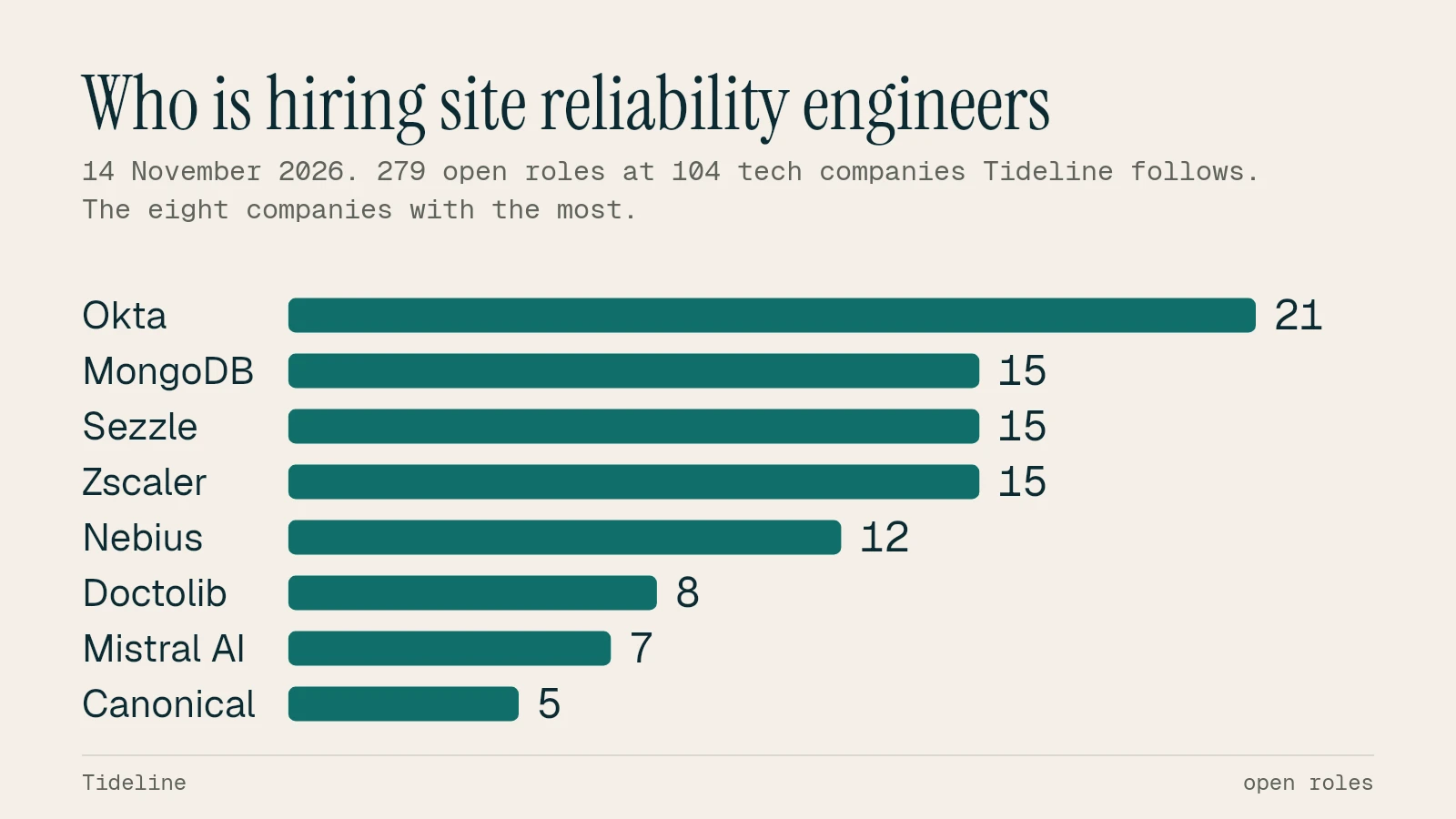
A site reliability engineer (SRE) is a software engineer whose job is keeping a company’s services reliable in production, by measuring reliability, automating routine operations and engineering the fixes. On 14 November 2026, 279 site reliability roles were open at 104 of the 720 tech companies Tideline follows. A third are marked remote, nearly two thirds are senior or above, and Okta, MongoDB, Sezzle and Zscaler have the most.
This article explains where the role comes from and the ideas behind it, what the job involves day to day, how it differs from DevOps and platform engineering, and what the numbers say about who is hiring, remote work, seniority and location. For the wider field, every open cloud, platform and DevOps role, see Cloud and DevOps jobs: who’s hiring today.
What is a site reliability engineer?
Site reliability engineering began at Google, and its book on the subject, Site Reliability Engineering, opens with a one-line description by Benjamin Treynor Sloss: “SRE is what happens when you ask a software engineer to design an operations team.”
The point of that line is the approach. Instead of a separate team that keeps systems running by hand, SREs are engineers who write software to run the systems, and who treat reliability as something to measure and design for. Google caps the operations work of its SREs (tickets, on-call and manual tasks) at 50% of their time, so that at least half goes to engineering work that makes services more stable and easier to run.
Three ideas from Google’s SRE book come up again and again in SRE job postings:
Service level indicators and objectives
A service level indicator (SLI) is, in the book’s words, “a carefully defined quantitative measure of some aspect of the level of service that is provided”: the share of requests that succeed, for example, or how long they take. A service level objective (SLO) is the target for that measure: say, 99.9% of requests succeed over a month. A service level agreement (SLA) is the contract with customers that sets out what happens if the objectives are missed. SREs choose the indicators, agree the objectives and watch them.
Error budgets
An objective below 100% leaves room for things to go wrong, and Google’s SRE book calls that room the error budget. If a service promises 99.9% availability, the remaining 0.1% is the budget for a quarter. While budget remains, teams keep releasing changes; when it runs low, releases slow down and effort goes into testing and stability. The book presents this as a shared, objective way for product developers and SREs to agree how much risk to take, instead of arguing about it case by case.
Toil
The book defines toil as the kind of work tied to running a production service that is manual, repetitive, automatable, tactical, without lasting value, and that grows in step with the service. The book lists six marks of toil: it is manual, repetitive, automatable, tactical (driven by interruptions rather than plans), it leaves nothing of lasting value behind, and it grows in proportion to the service. Restarting a stuck process by hand every week is toil; writing the automation that makes the restart unnecessary is engineering. Much of an SRE’s job is turning the first into the second, and the 50% cap exists so that the toil never crowds out the engineering.
What site reliability engineers do day to day
Three postings open on 14 November 2026 show the job in practice:
- MongoDB’s Site Reliability Engineer (Senior or Staff), Atlas builds and grows the multi-cloud platform behind MongoDB’s hosted database, builds automation and tools with the teams that own each service, and does the maintenance the fleet needs. It names AWS, Azure and Google Cloud, Linux, and Go, Ruby and Python. It can be hybrid at MongoDB’s New York headquarters or fully remote from the US Eastern or Central time zones, asks for five or more years of running critical systems at scale, and includes a 24/7 on-call rotation.
- MongoDB’s Site Reliability Engineer 3 works on infrastructure for a cloud service running hundreds of thousands of database clusters: automation and monitoring across cloud providers, and performance tuning from the application down to the hardware’s firmware. It asks for three or more years and names Linux and Kubernetes, with a weekly on-call rotation.
- Sezzle’s Senior Database Reliability Engineer builds reliability into its database platform rather than only reacting to failures: shared connection libraries, safe migration tooling, query standards, and the backups, failover and capacity planning of its AWS databases (MySQL and PostgreSQL on RDS and Aurora). It explicitly sets SLOs, SLIs, dashboards and runbooks, covers disaster recovery and security controls, and names a long list of tools: Prometheus, Grafana, Datadog and OpenTelemetry for observability, Kubernetes, Helm and Terraform for infrastructure, and Go and Python for code. The posting says it is not a traditional database administrator role. It is remote and asks for six or more years.
The common threads are cloud infrastructure (AWS appears in all three), Linux, a programming language for automation (Go and Python in two each), observability, and on-call. The experience asked runs from three years to six.
On-call
On-call is part of the job in most SRE postings. Both MongoDB postings name a rotation, one covering every hour of the week and one weekly, and Sezzle’s lists incident response among its duties. Google counts on-call inside the operations half of an SRE’s time, together with tickets and manual tasks, so a heavy on-call load counts against the cap that protects engineering time. When a posting says how often the rotation comes round, and from which time zones, that line tells you a lot about what the job will feel like week to week.
Site reliability engineer vs DevOps engineer vs platform engineer
The three titles share tools and often share teams, but each has its own centre:
| Site reliability engineer | DevOps engineer | Platform engineer | |
|---|---|---|---|
| Centre of the job | Reliability of services in production, measured with SLOs | Automating how software is built, tested, shipped and run | An internal platform that product teams use by themselves |
| Where the idea comes from | Google’s SRE book | The DevOps movement; AWS’s “What is DevOps?” | CNCF’s Platforms White Paper |
| Open roles, 14 Nov 2026 | 279 at 104 companies | 281 at 137 | 145 at 88 |
| Marked remote | 94 (34%) | 89 (32%) | 46 (32%) |
Google’s SRE Workbook sums up the relationship with DevOps in a line borrowed from programming: “class SRE implements interface DevOps”. DevOps describes the philosophy, joining development and operations; SRE is one concrete way of doing it, with its own targets and practices. In this data the two titles are almost exactly as common as each other, 279 against 281, and only 5 titles name both. DevOps Engineer Jobs: Which Companies Are Hiring Now covers the DevOps side in detail.
How many site reliability engineer jobs are open right now
The roles counted here, by the words in their titles:
| Title group | Roles | Companies |
|---|---|---|
| Site reliability engineer or SRE | 238 | 95 |
| Database reliability engineer | 13 | 5 |
| Other reliability titles (service, systems, platform, network, integration) | 11 | 6 |
| Production engineer | 11 | 4 |
| Customer reliability engineer | 6 | 3 |
| All | 279 | 104 |
Most are plain “site reliability engineer” titles, often with a level or team: Senior Site Reliability Engineer (30 postings), Site Reliability Engineer (22), Staff Site Reliability Engineer (9). Where a title names a team, storage and data come up most (33 titles), then cloud and platform (28), security (11), network (7) and observability (4). The smaller groups are a mixed set: service reliability engineers at Sony Interactive Entertainment, integration reliability engineers at Stripe, and platform, systems and network reliability titles at Apify, Cloudflare and Zenoti. Database reliability engineers apply SRE ideas to a company’s databases, as Sezzle’s posting shows. Production engineering is another name for similar work at some companies; here, Zscaler and Databricks use it most. Customer reliability engineers (Cloudflare, Tailscale and Sysdig) are counted too: their titles put the same reliability work in front of customers.
Almost all of these roles, 249 of 279, sit in Tideline’s cloud and DevOps field; 17 are in data (the database reliability roles) and 9 in cybersecurity. Hardware and manufacturing reliability roles are not counted: 12 such roles matched the words and were left out.
Companies hiring site reliability engineers
Twenty companies have four or more site reliability roles open, 152 of the 279 between them. Ten more have three each, 23 have two and 51 have one. Each company name links to its Tideline page, with every role it has open today.
Tideline is independent and is not affiliated with any company or job platform mentioned here. Company names are used only to identify where roles are open.
| Company | SRE roles | Main locations | Remote |
|---|---|---|---|
| Okta | 21 | Bengaluru (10), Washington (7), Bellevue (3) | 1 |
| MongoDB | 15 | New York (7), Dublin (6), Boston (5) | 0 |
| Sezzle | 15 | Bogotá (3), New Delhi (1) | 15 |
| Zscaler | 15 | Santa Clara (5), Crystal City (4), Bengaluru (3) | 4 |
| Nebius | 12 | Amsterdam (7), London (3), Berlin (2) | 7 |
| Doctolib | 8 | Paris (4), Berlin (3), Nantes (1) | 0 |
| Mistral AI | 7 | Paris (4), Amsterdam (3), London (3) | 2 |
| Canonical | 5 | No city given | 5 |
| Databricks | 5 | Mountain View (1) | 0 |
| GitLab | 5 | Bengaluru (3) | 2 |
| Grafana Labs | 5 | No city given | 5 |
| 5 | San Francisco (2) | 3 | |
| Sony Interactive Entertainment | 5 | Adelaide (2), Berlin (2), Aliso Viejo (1) | 0 |
| Wayve | 5 | Sunnyvale (3), Leonberg (1), Yokohama (1) | 0 |
| Cloudflare | 4 | Lisbon (2), London (2), Austin (1) | 0 |
| Five9 | 4 | Irving (2), San Ramon (2) | 0 |
| Legora | 4 | Malmö (2), New York (2), Stockholm (2) | 0 |
| Lightspeed | 4 | Montreal (2), Auckland (1), Toronto (1) | 0 |
| Plume | 4 | Hyderabad (2), Ljubljana (2) | 0 |
| Veeam | 4 | Bengaluru (1), Prague (1), Pune (1) | 0 |
Sezzle’s 15 are split between database reliability (8) and site reliability (7), all remote. Zscaler’s include its production engineering titles. MongoDB’s are spread across New York, Dublin and Boston, with several on its storage and security teams. Spread is the rule: no company has more than 8% of the roles, and half the companies (51 of 104) have a single opening.
Spotted an error or want a listing corrected? Email [email protected].
Remote site reliability engineer jobs
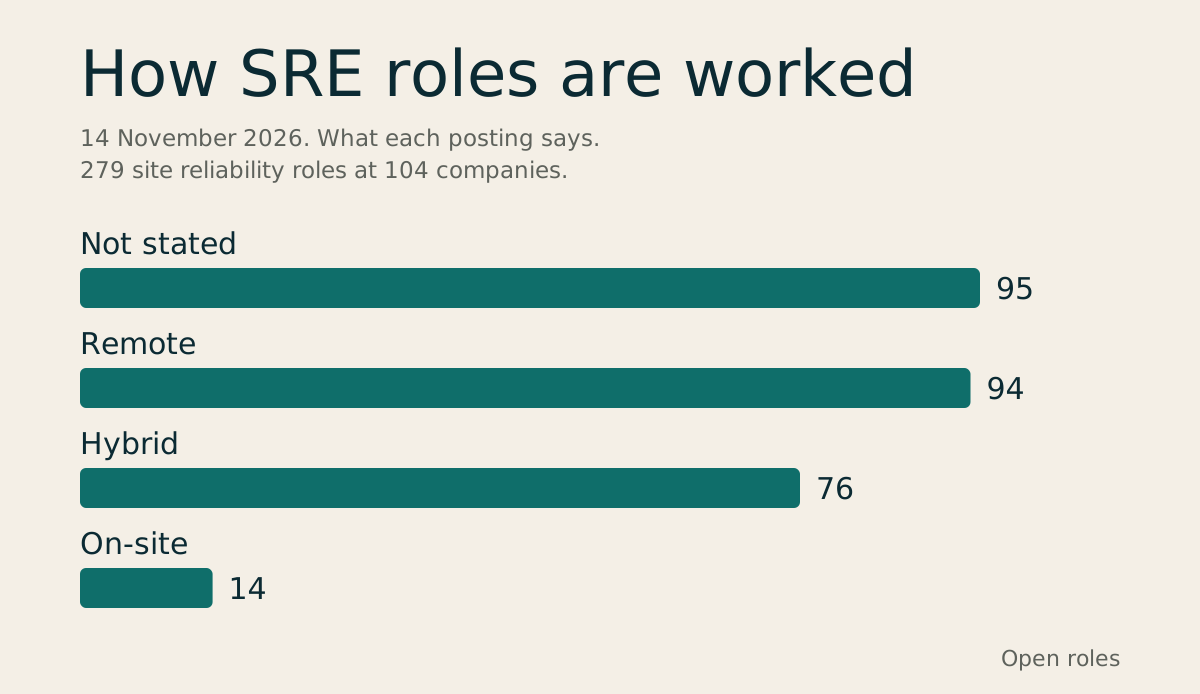
94 of the 279 site reliability roles are marked remote (34%), 76 hybrid and only 14 on-site; 95 don’t say. That is a little higher than DevOps (32%) in the same data.
The companies posting the most remote SRE roles are Sezzle (15), Nebius (7), Canonical (5), Grafana Labs (5) and Zscaler (4), then GoDaddy, Kong, Ping Identity, Reddit, Tide and Veeva Systems (3 each). Canonical and Grafana Labs post all of theirs as remote.
Where a remote SRE role says where you can be based:
| Where remote hires can be based | Roles |
|---|---|
| Not stated | 39 |
| United States only | 16 |
| A country or region in Europe | 13 |
| A country or region in Latin America | 9 |
| Anywhere in the world | 5 |
| The UK, or the UK and Ireland | 4 |
| India only | 2 |
| The United States and Canada | 2 |
| Other places or mixes | 5 |
Only 5 of the 94 are open worldwide. Time zones matter for on-call: MongoDB’s remote Atlas role, for example, is open only from the US Eastern or Central time zones.
Senior and junior site reliability engineer jobs
By the words in their titles:
| Level in the title | Roles |
|---|---|
| Senior | 112 |
| Staff | 56 |
| Lead | 8 |
| Principal | 1 |
| Manager or director | 29 |
| Mid level or a numbered level | 3 |
| Junior | 2 |
| Intern | 1 |
| No level in the title | 67 |
177 of the 279 (63%) say senior, staff, lead or principal, a higher share than DevOps (51%), and 29 are manager or director roles leading SRE teams, at 16 companies; MongoDB and Okta have four each and Tide three. Only three are open to people at the start of their careers: junior titles at VESSL AI and OneSpan, and an internship at Stripe. Tideline’s own rating of each title gives the same picture: 112 senior, 63 lead or staff, 29 managers or directors, 2 entry level.
The postings read for this article point the same way: they ask for three, five and six years or more of running systems in production.
Where site reliability engineer jobs are
| Country | SRE roles |
|---|---|
| United States | 96 |
| India | 39 |
| Germany | 21 |
| United Kingdom | 19 |
| France | 14 |
| Ireland | 13 |
| Canada | 11 |
| Netherlands | 10 |
| Poland | 9 |
| Spain | 9 |
A role can list more than one place, so these overlap, and 10 roles name no country. By city, Bengaluru leads (22), ahead of New York (20) and San Francisco (19), then Berlin (14), Paris (12), London and Washington (11 each), Amsterdam (10) and Dublin (9). Europe has a strong share: Germany (21), France (14), Ireland (13), the Netherlands (10), Poland and Spain (9 each) are all in the top ten, with Doctolib, Mistral AI, Nebius and MongoDB’s Dublin roles among them.
Finding site reliability engineer jobs on Tideline
- Cloud and DevOps jobs: who’s hiring today lists every open role in the field, with today’s numbers, as the page loads.
- Search for “site reliability”, live, and narrow by country, remote and work setting.
- Each company above has its own page on Tideline with every role it has open, such as Okta or MongoDB.
- For DevOps titles, see DevOps Engineer Jobs: Which Companies Are Hiring Now; for remote roles across every tech field, Remote IT Jobs.
Every role links to the employer’s own page. Before you apply, Readback shows your resume the way the hiring software on the other side reads it.
How this data was collected
Tideline reads the public job boards of the 720 tech companies it follows, once a day each, on Greenhouse, Ashby, Lever, Teamtailor, Workable and Personio. It does not read job sites or aggregators, and it does not cover every employer. On 14 November 2026, 714 of those companies had open roles, 36,878 in all.
A role counts here when its title contains “site reliability” or “SRE”, or a software reliability or production engineering title (“reliability engineer”, “production engineer”), as whole words, in any field except Tideline’s “other functions”. Hardware, manufacturing and data-centre reliability titles are left out.
Data notes:
- 12 hardware, manufacturing, data-centre and events titles that matched the words are left out, among them hardware and electrical reliability engineers and a propulsion production engineer.
- Customer reliability engineers (6) are counted: their titles are software reliability work facing customers.
- 5 titles name both DevOps and SRE; they are counted in both this article and the DevOps one.
- Title groups come from the words in each title; the team words (storage, cloud, security, network, observability) are counted once per title, in the first that matches.
- Levels come from the words in each title; Tideline’s own rating is given beside them.
- The postings described were read on 14 November 2026; postings change, and the setting, tools and experience asked vary by team.
- The figures describe the companies Tideline follows on 14 November 2026, not the whole market for these roles.
Common questions
- What does site reliability engineer mean?
- A site reliability engineer is a software engineer who looks after how reliably a service runs in production. The idea comes from Google, whose SRE book describes SRE as what happens when you ask a software engineer to design an operations team. SREs set reliability targets, measure them, automate repetitive operations work and take part in on-call.
- Which companies are hiring site reliability engineers?
- On 14 November 2026, among the 720 tech companies Tideline follows, Okta had the most site reliability roles open (21), then MongoDB, Sezzle and Zscaler (15 each), Nebius (12), Doctolib (8) and Mistral AI (7). 104 companies had at least one.
- Are site reliability engineer jobs remote?
- About a third are. Of the 279 site reliability roles open on 14 November 2026, 94 were marked remote, 76 hybrid and 14 on-site; 95 didn't say. Where a remote role says where you can be based, the United States alone and Europe are the most common answers; only 5 were open worldwide.
- What is the difference between an SRE and a DevOps engineer?
- DevOps is a broad way of working that joins development and operations; site reliability engineering is a narrower, more concrete job focused on reliability, with targets such as service level objectives and error budgets. Google's SRE Workbook puts it as "class SRE implements interface DevOps". In Tideline's data the two titles are about equally common: 279 SRE roles and 281 DevOps roles on 14 November 2026.
- What is an error budget?
- An error budget is the amount of unreliability a service is allowed in a period, worked out from its reliability target. If the target is 99.9% availability, the budget is the remaining 0.1%. Google's SRE book describes using it to decide when to keep releasing changes and when to slow down and work on stability.
- Are there junior site reliability engineer jobs?
- Very few. Of the 279 site reliability roles open on 14 November 2026, 2 had a junior title (VESSL AI and OneSpan) and 1 was an internship (Stripe). 177 said senior, staff, lead or principal, and 29 were manager or director roles.
Sources
- Google: Site Reliability Engineering, Introduction sre.google
- Google: Site Reliability Engineering, Service Level Objectives sre.google
- Google: Site Reliability Engineering, Embracing Risk sre.google
- Google: Site Reliability Engineering, Eliminating Toil sre.google
- Google: The Site Reliability Workbook, How SRE Relates to DevOps sre.google
- MongoDB: Site Reliability Engineer (Senior or Staff), Atlas (posting read 14 Nov 2026) mongodb.com
- MongoDB: Site Reliability Engineer 3 (posting read 14 Nov 2026) mongodb.com
- Sezzle: Senior Database Reliability Engineer (posting read 14 Nov 2026) job-boards.greenhouse.io
- Greenhouse Job Board API developers.greenhouse.io
- Lever Postings API github.com
- Ashby public job posting API developers.ashbyhq.com